Emotion Coaching vs. Emotion Dismissing: How Your Reaction to Big Feelings Shapes Your Child
Have you ever heard yourself say something to your crying child and thought, Why did I just say that?
"You're fine."
"It's not a big deal."
"Stop crying."
You're not trying to be dismissive. You're trying to help, to bring the temperature down, to get everyone out the door on time. But the words don’t land the way you intended and the things get louder anyway. Now everyone’s more upset than they were ten seconds ago, and you're stuck wondering how your attempt to calm things down just poured fuel on the fire.
Here's what you might not know. In those chaotic moments, the thing that most shapes your child’s behavior isn't the feeling they're having. It's how you respond to it. And most of us respond on autopilot, responding from a script we never chose.
That script tends to run in one of two directions. And we have a good idea of where each one leads, because someone spent decades studying it.
The Two Patterns, According to the Research
In the 1990s, psychologist Dr. John Gottman and his colleagues set out to understand how parents respond to their children's emotions. They found that most parents fall into one of two parenting styles. Gottman named them emotion coaching and emotion dismissing.
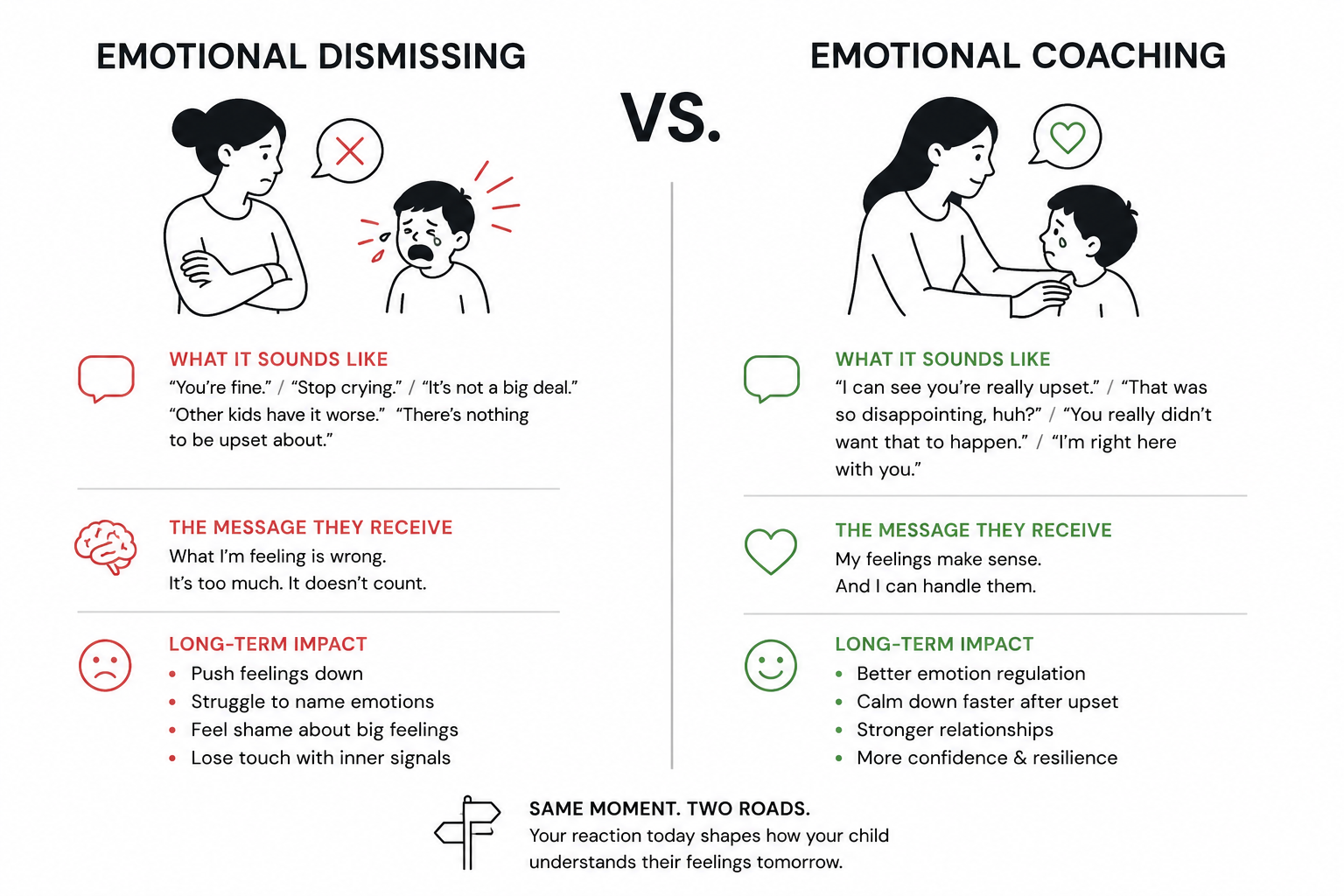
Underneath both is something he called "meta-emotion," which is just a more technical way of saying how you feel about feelings, both your child's and your own. Some parents see a child's distress as something to move toward. Others see it as a problem to avoid, ignore or shut down as fast as possible.
(Gottman actually described several additional parenting categories of , but they share the same root: treating the emotion as something to get rid of rather than a moment to connect.)
Honestly, most of us play the role of dismisser and coach, depending on the day, the hour, and how much sleep we got. But over months and years, whichever pattern your child gets most will quietly shape how they come to understand their own feelings. Let's take a closer look.
What Emotion Dismissing Actually Sounds Like
Emotion dismissing is when a child's feelings get invalidated, minimized, or shut down. Not out of cruelty. Usually the opposite.
It sounds like:
"You're fine."
"Stop crying."
"It's not a big deal."
"Other kids have it way worse."
"There's nothing to be upset about."
In Gottman's research, dismissive parents were usually deeply well-meaning. They tend to view negative emotions as harmful, even a little dangerous, and they believed that the kindest thing they could do is make the bad feeling go away quickly so their child doesn't have to sit with it. Take a second to step into the s body of a child who’s been invalidated. What they receive isn't a message to "calm down." It's closer to:
"What I'm feeling is wrong. It's too much. It doesn't count."
When that message is received again and again, kids tend to learn to:
Push feelings down instead of moving through them
Struggle to even name what they're feeling
Feel a flicker of shame whenever a big emotion shows up
Slowly lose touch with their own inner signals
Have difficulty solving problems

What Emotion Coaching Actually Sounds Like
Let's clear up a misconception right away: emotion coaching does not mean approving of every behavior. It doesn't mean that you should give in, or that there are no limits.
A parent who coaches treats the child’s feeling as valid and a source of useful information, even while the behavior still requires boundaries. Gottman found that parents who do emotion coaching tend to do a few things consistently: they notice the emotion, they treat it as a chance for closeness and teaching, they help the child put a name to what they're feeling, and they support them in figuring out what to do with it.
It sounds like:
"I can see you're really upset."
"That was so disappointing, huh?"
"You really didn't want that to happen."
"I'm right here with you and we can figure this out together.
Instead of slamming the door on the emotion, you help your child walk through it. The message they receive flips entirely:
"My feelings make sense. And I can handle them."
And this isn't just about being warm and fuzzy. In Gottman's follow-up research, children of emotion-coaching parents tended to regulate their emotions better, calm down faster, get along better with other kids, and show fewer behavioral problems over time. The small everyday coaching moments added up into something measurable.
Same Moment. Two Roads.
Picture it: your child loses a game and bursts into tears.
Emotion dismissing: "Stop crying. It's just a game. We can play again tomorrow."
Emotion coaching: "You really wanted to win, I get it. It's really frustrating to lose a game."
Identical situation. The trigger, the tears, the timing, all of it the same. But the road each response sends your child down could not be more different. One leaves them alone with something that feels too big. The other tells them they're not alone in it.
Why Dismissing Backfires (It's Biology, Not Stubbornness)
When your child is flooded with big feelings, their amygdala, the brain's alarm system, has taken over. The thinking part of their brain, the one that handles logic ("it's just a game") and the ability to calm themselves down, has temporarily gone offline. It's not that they’re being stubborn. It’s that they physically cannot access reason at that moment.
So when you say "You're fine, it's not a big deal," you're trying to use logic with a brain whose logic center is shut down. . That's why it bounces off. That's why it often makes things louder, because now their alarm is reading you as one more thing that doesn't feel safe.
Kids aren't born with the ability to calm themselves down. They learn it through co-regulation, by borrowing the calm of a steady adult, over and over, until one day they can generate it on their own. This is exactly what emotion coaching does in the moment, and exactly what dismissing skips. Regulation isn't taught in a lecture after the fact. It's absorbed, in real time, through your presence and validation..
"But Isn't Coaching Just... Too Soft?"
I hear this a lot in my practice:
"If I keep validating feelings, won't my child become spoiled, entitled or think their behavior is acceptable?"
It's a fair question. And the research actually points in the opposite direction. Kids who feel genuinely understood don't have to keep escalating to be heard. The escalation is often just your child turning up the volume because their first attempt wasn’t heard .
Coaching and firmness are not opposites. You can hold both at once:
"I won't let you hit. And I can see how angry you are."
"You're really upset, and the answer is still no."
You can teach two things in the same breath: emotions are safe, and behavior still has limits. Kids can hold both. That combination is exactly what builds emotional strength and resilience.
Why Coaching Is So Hard to Do in Real Time
If emotion coaching feels unnatural, there's a good reason.
Most of us were not coached through our own emotions growing up. For a lot of us, feelings were minimized, ignored, or corrected as fast as possible. So when your child melts down, your nervous system reaches for the only template it has. Quick fix. Shut-down.. Move along.
That's not a character problem. That's a modeling problem. You're running software that was installed way before you had any say.
Which means the first step isn't a parenting course or guidebook. It's awareness. Learning to catch your automatic response a half-second sooner each time.

A Simple Way to Start Coaching
You don't need to memorize a script–just point yourself in the right direction.. Try this:
1. Notice. Pause. Observe. What might your child be feeling beneath the behavior?
2. Name It. Put words to it. "You seem really disappointed."
3. Normalize. Let it make sense. "Of course you're upset; you were so excited for that."
4. Support. Stay present. No fixing required. Your steady presence is the help.
Notice what's not on this list: solving the problem, explaining why it's not worth crying over, distraction, or making the feeling disappear. That all comes later, if at all, and it lands so much better once the brunt of the storm has passed.
And When You Get It Wrong (Because You Will)
There will come a day when you dismiss a big feeling and you’ll probably get to watch it backfire in real time. Every parent does, including the ones who study this for a living.
In those moments, what matters most is how you fix it–: the repair. That means talking to your child when calmer heads prevail, and saying, "Hey, you were really upset earlier and I was short with you. That wasn't fair. I'm sorry."
The repair teaches your child something critical: connection can break and it can be restored. It teaches that a bad moment doesn't cost them your love.
When to Reach Out for Support
Big feelings, and the occasional dismissive response, are completely normal parts of family life. But it might be worth talking to a professional if you're noticing:
Your child consistently can't recover from disappointments, even with your support
The intensity is getting in the way of school, friendships, or daily life
Emotional reactions regularly tip into hurting themselves or others
You're seeing persistent shame or self-blame ("I'm bad," or something's wrong with me.")
The strategies that work for other kids just don't work for yours, and you feel stretched past your limit
Reaching out early isn't a sign that something is seriously wrong. It just means you're being proactive and getting support before things get bigger.
The Bigger Picture
Parenting is never about nailing every single moment perfectly–none of us do. It's about the patterns your child experiences over time.
Do they generally feel shut down by their most trusted adults or do they feel seen, heard and understood?
Because long after the tantrums and the tears are a distant memory, their internal voice remains. The way they talk to themselves when something goes wrong. The voice that says either "My feelings don't make sense. I can't cope" or "My feelings are valid, and I can handle them."
That voice is shaped, in large part, by yours.
One Last Thing to Sit With
Your child feels things deeply. Not to make your life harder. Not to manipulate you. But because that's how their nervous system is wired. And as their parent, you are the person they bring their messiest, ickiest feelings to. That can be exhausting in a way that's genuinely hard to explain to anyone who isn't living it. It stretches your patience in ways you never imagined were possible. But it also means something really important is already true: your child trusts you with what feels big.
You won't get every response right. You don't have to. Emotion coaching isn't a one-time performance. It's a direction you keep turning back to day after day. . Every time you pause long enough to understand instead of dismiss, you're building strength and resilience, qualities they'll carry and return to long after the hard moments have passed.
That's not a small thing. That's the whole thing.
Programs to Support Your Family
SPACE Parenting Course:
Learn strategies to reduce childhood anxiety and support emotional regulationDBT-C Parent Group:
Skills for supporting emotional independence while reducing family stressSSP - Safe and Sound Protocol:
Research-based listening therapy to help regulate the nervous system
About the Author
Suri Nowosiolski, LCSW, MSpEd, is a licensed clinical social worker with over 30 years of experience supporting children, teens, and the parents who love them. She is the founder of Hearts & Minds Psychotherapy Group in Valley Village, CA.
Related Posts
📌 What's Actually Happening in Your Child's Brain When Big Feelings Take Over- Demystifying the neuroscience behind emotional meltdowns to help parents co-regulate and restore calm.
📌 Why Your Child Reacts Before They Can Think (And What to Do in That Split Second) - Understanding the high-speed threat response that bypasses logic, with real-time intervention strategies for parents.
📌 Is Your Child a Supersensor? - Understanding the Highly Tuned Nervous System - Identifying the unique signs of deep empathy and sensory sensitivity in children who process the world intensely.
📌Anxiety IQ: A Kid's Guide to Understanding and Managing Anxiety - Explaining the biology of an overprotective internal alarm system with simple, kid-friendly analogies.