What's Actually Happening in Your Child's Brain When Big Feelings Take Over
You've watched it happen dozens of times. Something small goes wrong: the wrong cup, the lost game, the plan that changed. Within seconds your child is completely overwhelmed. And you're standing there thinking: why does everything have to be this big?
It can feel personal. Like something you've done or haven't done. Like you're missing something every other parent seems to have figured out.
You're not. And there's a reason this keeps happening that has nothing to do with your parenting and everything to do with how your child's brain is built right now.
Their Brain Is Doing Exactly What It's Designed To Do
Emotional intensity in children isn't a flaw. It's biology.
Every human brain has two systems that are in constant conversation. The first is the amygdala, a small but powerful region that acts like your child's internal alarm system. It scans the environment for anything that feels threatening, and when it detects something, it fires fast. The second is the prefrontal cortex, the part of the brain responsible for logic, reasoning, and pulling the brakes on big reactions.
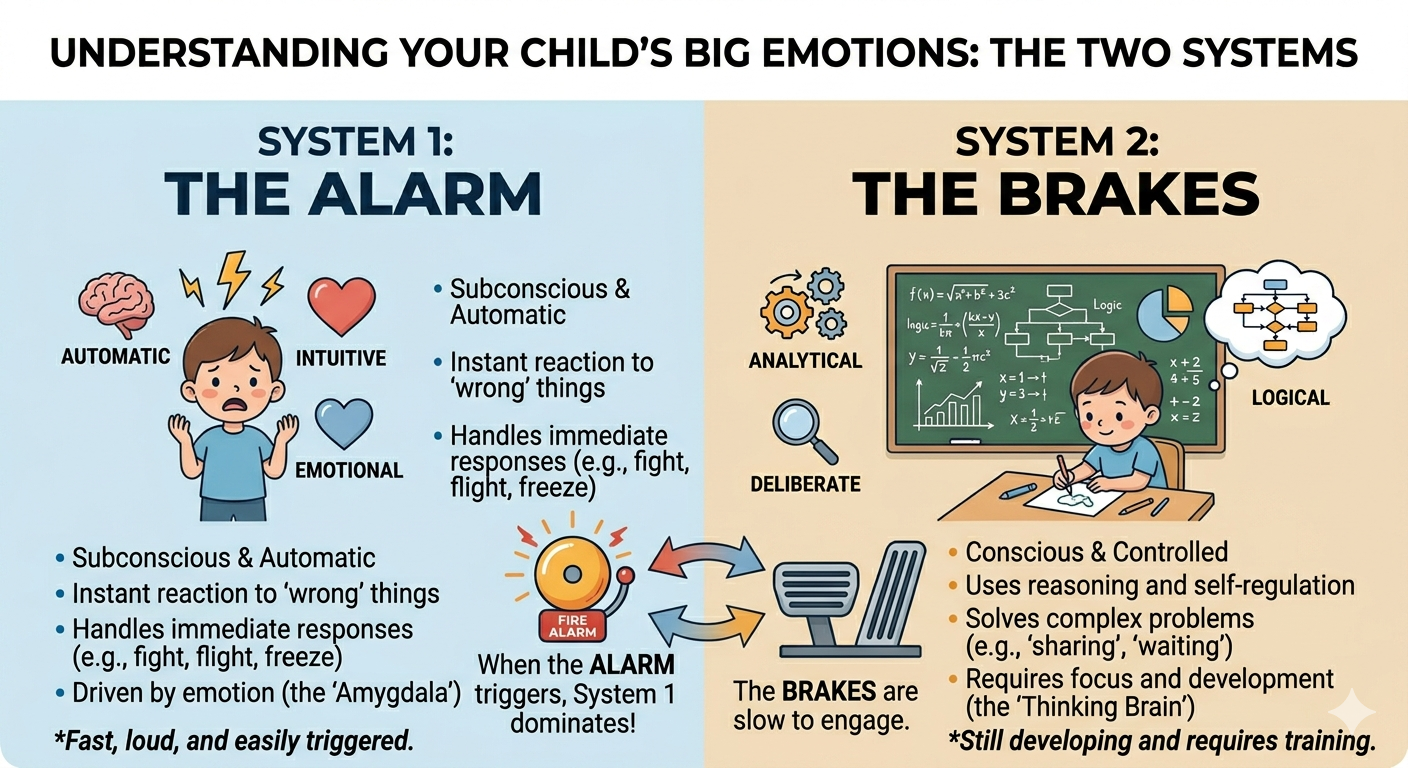
In adults, these two systems have had decades to calibrate. In children, especially those with naturally sensitive nervous systems, the alarm fires quickly and loudly while the braking system is still very much under construction. That gap between alarm and brakes is where your child lives when things get hard.
The prefrontal cortex doesn't fully mature until the mid to late twenties. So what you're witnessing in these moments isn't defiance. It's a developmental reality.
Why Some Kids' Alarms Are Louder Than Others
All children have this gap, but not all children experience it the same way. Some kids have a nervous system that is simply wired to be more sensitive and more reactive. Researchers have different terms for describing this sensitivity, , but it's estimated to show up in about 15 to 20 percent of children.
For these kids, the volume on everything is turned up. That can look like:
Physical sensations that feel genuinely overwhelming — a scratchy tag, a loud room, a light that's too bright
Emotional experiences that land much harder than you'd expect from the situation
Transitions that feel disorienting even when they seem like no big deal to you
Feedback that seems neutral to you but lands as sharp or hurtful to them
This isn't something they're doing on purpose, and it isn't a weakness. Their nervous system is processing more information, more deeply, than the average child's. The same wiring that makes the hard moments feel enormous is also what makes your child perceptive, empathetic, and capable of real, deep connection.
What Goes Offline During a Big Feeling
When your child's alarm fires, their thinking brain genuinely goes offline for a period of time. During that window, they are not capable of:
Reasoning through a problem
Negotiating or compromising
Hearing and processing your logic
"Using their words" in any meaningful way
Accepting feedback or correction
This is why so many in-the-moment strategies don't work. The words and the thinking are simply not available when the alarm is this loud. What the brain needs first is for the alarm to soften. Then, and only then, can the thinking brain come back online.
You may also notice your child holds it together at school all day and then falls apart the moment they walk through your door. This is actually a sign of healthy attachment. They feel safe enough with you to let it out. That's not a burden you've earned. That's trust.
What You Can Actually Do With This
Understanding the brain science only helps if it changes something about how you respond. And it can, but it looks different depending on where your child is at the moment.
Before the alarm fires:
This is your window of opportunity. When your child is calm and regulated, their thinking brain is fully online and actually available to learn. This is the time to:
Practice calming tools together (breathing, movement, a calm-down space) so they become familiar, and they’ve developed some real muscle memory around this skills for when things get hard
Talk about feelings using simple language tied to what's happening in the body: "I notice your shoulders are up by your ears — that's sometimes what stress feels like"
Build predictability into your day, because a nervous system that knows what's coming next doesn't have to stay on high alert
Recognize and praise the positive opposite of your child’s problem behaviors
When the alarm is already going:
This is not the time to teach, reason, give feedback or problem-solve. What helps here is much simpler:
Lower your own voice, soften your posture, slow down. Your nervous system is information to your child's nervous system. When you stay calm, you are literally helping their brain find its way back
Stay close without demanding anything. "I'm here" is enough
Skip the words for now. Presence matters more than explanation in this moment
This is called co-regulation, and it's one of the most effective tools parents have. The idea is straightforward: children borrow calm from the regulated adults around them before they're able to generate it themselves. You don't have to be perfect at it. You just have to be willing to try..
The Part Parents Often Carry Alone
When your child reacts intensely, it's hard not to take it personally. Hard not to replay the moment and wonder what you could have done differently. Hard not to worry about what it means for them down the road.
That self-doubt is real, and it's worth naming. Parenting a big feeler is genuinely exhausting in a way that parents of more even-tempered kids can’t fully understand. You are not overreacting to how hard this is. You are doing something that requires enormous patience, creativity, and emotional bandwidth every single day.
Knowing the brain science doesn't make the hard moments disappear. But it does change what you're doing inside those moments. When you understand that your child's reaction is a nervous system response rather than a behavior choice, it becomes a little easier to stay grounded yourself. And your groundedness, as it turns out, is one of the most powerful tools you have.

One Place to Start
You don't need a full new strategy today. Start with one question the next time things get hard:
Is my child's alarm firing right now, or are they calm enough to actually hear me?
The answer to that question tells you everything about what to do next. If the alarm is going, your job is just to stay close and stay calm. The teaching, the talking, the correction, the problem-solving — all of that comes later, and it will land so much better when the brain is ready for it.
A Note to Sit With
Your child didn't choose to feel everything this deeply. And you didn't choose to be the parent on the receiving end of it, day after day, often without much of a roadmap.
But here's what's true: the fact that you're reading this, trying to understand what's happening inside your child rather than just trying to stop the behavior, matters more than you know. That curiosity — that willingness to look beneath the surface — is exactly what your child needs from you.
You won't get it right every time. Neither will they. But every moment you stay present, every time you choose to understand before you react, you are building something in your child that lasts far longer than any single hard day.
That's not a small thing. That's the whole thing.
Programs to Support Your Family
SPACE Parenting Course:
Learn strategies to reduce childhood anxiety and support emotional regulationDBT-C Parent Group:
Skills for supporting emotional independence while reducing family stressSSP - Safe and Sound Protocol:
Research-based listening therapy to help regulate the nervous system
About the Author
Suri Nowosiolski, LCSW, MSpEd, is a licensed clinical social worker with over 30 years of experience supporting children, teens, and the parents who love them. She is the founder of Hearts & Minds Psychotherapy Group in Valley Village, CA.
Related Posts
📌 Helping Your Child Understand and Manage Their Emotions - Building the emotional intelligence your child needs for better connection.
📌 When Goodbye Feels Impossible: Navigating the Waves of Separation Anxiety With Your Child - Navigating the stages of separation with calm, supportive transitions.
📌 When Small Moments Feel Like Big Rejections: Understanding Rejection Sensitive Dysphoria in Children - Helping children manage the intense emotional sting of perceived rejection.
📌 When Your Child Feels Everything: Understanding Deeply Feeling Kids – Practical DBT-C skills to help sensitive children manage intense emotional waves.